































Guide · Trading Cards · 7 minute read
How to Read a Slab Label
Part 2 of 6 Grading Explained
Published
A slab label is a short summary of the grader's record for that card: what the card is, the grade it was given and a certification number that links back to the grader's database. Once you know where to look, you can read one in seconds and check it before you buy.
What you'll learn
- Where the grade and certification number sit on six graders' labels
- What qualifiers and subgrades add to a single grade
- How a signed card's label separates the card grade from the signature
- How to use the certification number to check a slab
What every label tells you
Layouts differ from grader to grader, and have changed over the years, but almost every label carries the same four kinds of information:
Reading a label, grader by grader
Each grader puts the same four things in a different place. Pick a grader to see where each one sits, or compare all six at once. Where a grader has more than one kind of label, switch between the examples above the photo.
A PSA label
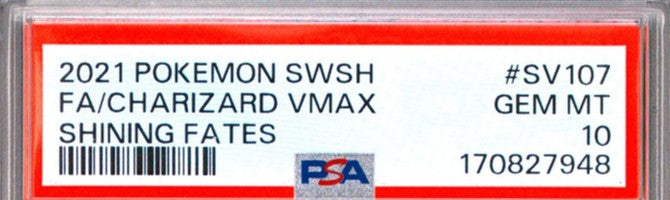
- 1The cardYear, game and series (2021 POKEMON SWSH: Sword & Shield), the name with PSA's code for its version in front (FA/), the set, and the card number from the Shiny Vault (#SV107).
- 2The gradeGEM MT, with the number 10 on the line below it. A qualifier such as OC (off-centre) or MK (marks) would sit beside the grade.
- 3The certification number170827948, bottom right. Type it into PSA's website to see the record for this slab.
- 4Also on the labelA barcode, bottom left. PSA's current LightHouse labels also have a QR code on the back that opens its Cert Verification.
A qualifier means the card was given that grade with one specific flaw noted. And a few cards get no number at all. PSA can label a card it has confirmed is genuine but can't grade "Authentic". A card it finds has been altered, for example trimmed or recoloured, may be labelled "Authentic Altered", but only at the grader's discretion and when the submission allows for that result; otherwise it comes back ungraded.
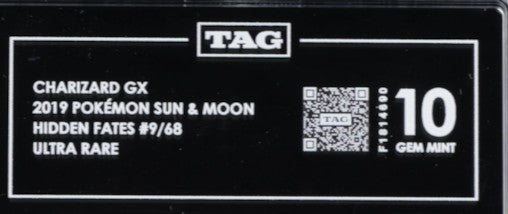
A TAG label
There's no paper label in a TAG slab: the details are printed into the case itself. Scan the QR code, or look up the certification number on TAG's website, to open the DIG report, with photos of the card, the defects TAG found and, on services that include it, the 1,000-point TAG Score that places the card within its grade.
Above Gem Mint 10 sits TAG's Pristine 10, for cards scoring 990 to 1,000. Not every service includes the TAG Score, but every card that reaches Pristine 10 is given one.
A BGS label
- Black Pristine 10 with four 10 subgrades, the "Black Label"
- Gold Other Pristine 10s and Gem Mint 9.5s
- Silver Every other grade
Not every BGS slab has subgrades: they're given when the submission includes them. A lower subgrade often helps explain why the overall grade isn't higher, but Beckett weighs all four together, so the overall grade isn't simply the lowest score. New labels have a QR code for checking the certification on Beckett's website.
A CGC label
Every card that earns a Pristine 10 gets the gold Pristine 10 label. A Gem Mint 10 is a 10 overall where one of the grading criteria falls short of Pristine. The certification number is on the front, next to the barcode, and there's a QR code on the back of the label to scan with your phone. Microprinting, UV ink and holographic foil make the label hard to copy.
CGC stopped giving subgrades on cards received from July 2023, and subgrades from older labels aren't printed on its current labels. Cards it graded Gem Mint 9.5 before then count as Gem Mint 10 on its current scale.
An SGC label
The small badge beside the 10 is the quickest way to tell SGC's two top grades apart. SGC's black labels use a 7-digit certification code; its green and white labels use 11 characters, in the form XXXXXXX-XXX. Enter the whole code in SGC's cert code lookup.
An ACE label
ACE grades from 1 to 10, with 10 Gem Mint at the top. It looks at centring, corners, edges and surfaces, and no card can have a total grade more than one grade above its lowest subgrade. Look the certification number up on ACE's website to see the subgrades, and a grading report if one was bought.
ACE offers three label designs: Standard, in black and gold; Colour Match, which picks up the two most prominent colours on the card; and the Ace Label, shown here, where ACE's own illustrators extend the card's artwork across the label. The design is a choice made when the card is sent in. It doesn't change the grade.
All six labels compared
| Question | PSA | TAG | BGS | CGC | SGC | ACE |
|---|---|---|---|---|---|---|
| Top grades | 10 Gem Mint | Pristine 10, then Gem Mint 10 | Pristine 10: black label with four 10 subgrades, otherwise gold; then gold 9.5 Gem Mint | Pristine 10 on a gold label, then Gem Mint 10 | Pristine 10 (gold label, PRI badge), above Gem Mint 10 (GM badge) | 10 Gem Mint |
| Behind the grade | Qualifiers such as OC or MK | DIG report; TAG Score on some services, and on every Pristine 10 | Four subgrades, when given | Gem Mint 10 falls short of Pristine on one criterion; no subgrades since July 2023 | The badge beside the 10: PRI or GM | Subgrades on the online record; total capped one grade above the lowest |
| Certification number | Bottom right; barcode bottom left | Sideways by the QR code | On the label; QR code on new labels | Front, beside the barcode | 7 digits (black); XXXXXXX-XXX (green, white) | Front and back, with a barcode |
| Check it | QR code on the back of current labels, or PSA's website | QR code, or TAG's website | QR code, or Beckett's website | QR code on the back, or CGC's website | SGC's cert code lookup | QR code on the back, or ACE's website |
PSA 10 label photographed by VaultifyUK. TAG Gem Mint 10 label from the VaultifyUK collection. Other label photos used with permission. Card images © their owners, including The Pokémon Company International. Grading details from each grader's own website, checked 16 November 2026.
Signed cards: the card, the signature, or both
As Part 1 explained, a card's condition and its signature are checked separately. A signed card's label tells you which checks were done. These are the three arrangements you'll see most often, and each grader words them its own way.


Pikachu and Bruno Fernandes slabs photographed by VaultifyUK; Messi slab photo used with permission. Tap a photo to see it full size. Pikachu card image © The Pokémon Company International.
Two grades, two questions. A 10 autograph doesn't make the card a 10. On a dual-graded slab the card's condition and the signature are assessed separately, so a card with a soft corner can be a Mint 9 while its signature is an Auto 10. Check which number is which before you compare prices.
1. The signature only
Here only the autograph is authenticated, and perhaps graded. The card's condition isn't graded at all. The Pikachu V promo above, signed by Veronica Taylor (the original English voice of Ash), shows how this looks: the label names the signer rather than the set, and "AUTO GRADE … GEM MT 10" is for the signature alone.
2. The card graded, the signature certified by its maker
The Bruno Fernandes card is the other common case from Part 1: an autograph certified by the manufacturer. Topps prints "Topps Certified Autograph Issue" on the front, and the back says the signing was witnessed by a Topps representative. PSA has graded the card, a 9, and the label names it as an autograph version. It hasn't given the signature a grade of its own.
A close relative is a card grade with a signature the grader has authenticated but not scored. CGC, for example, uses "AU" for an authentic autograph that hasn't been graded: the signature has been checked and passed, but no one has scored how good it is.
3. A grade for the card and a grade for the signature
With a dual-grading service, the card gets its condition grade and the signature gets its own grade, and both are printed on the label, each clearly named. PSA's Card and Autograph Dual Service gives each its own number from 1 to 10. On the Lionel Messi above, PSA prints the card's grade, MINT 9, with the autograph's grade, AUTO 10, on the line below it, and "PSA/DNA CERT" shows the signature was authenticated by PSA's autograph team.
Beckett shows both grades too, but in its own way: the autograph grade sits in a separate box beside the card's label. This Gleyber Torres is a 9.5 Gem Mint card, with four subgrades of 9.5, and its signature is a Beckett 10 Autograph. It's also a Topps Certified Autograph Issue, so a maker's autograph can still be given an autograph grade when it's sent in for one.

CGC prints the autograph grade on the front of the label alongside the card's grade. Whichever grader it is, the two numbers are separate assessments and often differ: the card might be a 9 and the signature a 10, or the other way round.
What earns a higher autograph grade
Authentication comes first and answers one question: is the signature genuine? Only then can it be graded. Each grader publishes its own standards and weighs things its own way, but these come up again and again:
Illustrations, not real cards.
The scales aren't the same everywhere. PSA grades autographs from 1 to 10. Beckett and CGC use whole numbers only, and CGC's scale starts at 5: a genuine signature below that is simply marked authentic.
Some pack-pulled autographs are signed on a clear sticker that's then applied to the card, rather than on the card itself, and Beckett's standards allow for part of a sticker being hidden or missing at lower grades. A signature that has been retraced or touched up is a different matter: PSA won't give it a number grade, even if it can still authenticate it.
Checking a label against the grader's record
Type the certification number into the grader's own website, rather than following a QR code or link someone sends you, and check that the card, the grade and any autograph details match the label in front of you. Each grader's lookup page:
- PSA cert lookup (opens in a new tab)
- TAG cert lookup (opens in a new tab)
- BGS cert lookup (opens in a new tab)
- CGC cert lookup (opens in a new tab)
- SGC cert lookup (opens in a new tab)
- ACE cert lookup (opens in a new tab)
A match is a good start, but it doesn't prove the slab is genuine, because fakes can copy real numbers. Part 5 of this series, on 13 December, covers spotting a tampered or fake slab.
For what each grade means at all six companies, see our card grade scales.
Next in Grading Explained: What Graders Look For, on 29 November, looks at how centring, corners, edges and surface affect a card's grade.